

PCD vs PCBN — the two superhard cutting materials are usually mentioned in the same breath, but they are not interchangeable. Choosing the wrong one wastes tool cost and destroys surface finish. This guide explains what each material is, where it wins, and how to decide between PCD and PCBN.
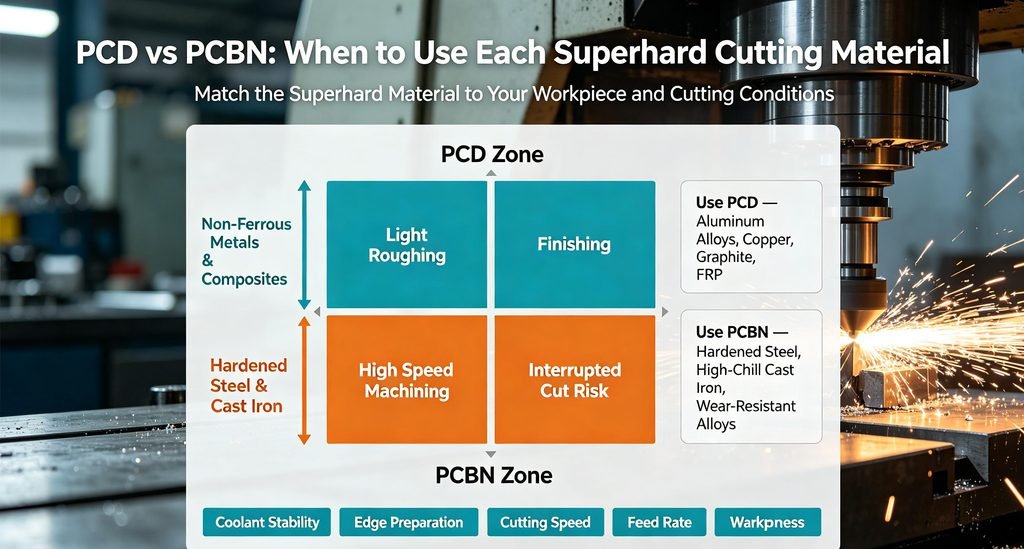
PCD vs PCBN: what they are
Both are polycrystalline superhard materials made by sintering tiny crystals under extreme pressure and temperature, in the same family as diamond and cubic boron nitride:
- PCD (polycrystalline diamond) is made from diamond crystals sintered with a metal binder onto a carbide substrate.
- PCBN (polycrystalline cubic boron nitride) is made from cubic boron nitride crystals, usually with a ceramic or metal binder.
The key physical difference is chemical: diamond reacts with iron at cutting temperatures, while CBN does not. That single fact drives almost every PCD vs PCBN decision below.
PCD vs PCBN: the rule of thumb
- Non-ferrous materials → PCD. Aluminium, copper, brass, zinc, composites, plastics, carbon fibre, graphite, and most non-metals.
- Ferrous and superalloy materials → PCBN. Hardened steel, tool steel, cast iron, high-chrome and nickel-based superalloys.
When to choose PCD
PCD is the highest-wear-resistance edge you can put on a non-ferrous workpiece, and it holds an extremely sharp edge. Typical PCD uses:
- High-volume aluminium machining — automotive pistons, cylinder heads, gearbox housings.
- Mirror finishing where an ultra-sharp, polished edge is required.
- Non-ferrous composites and metal matrix composites, where tool life dominates cost.
- Woodworking and plastic cutting at high feed rates.
PCD inserts often run at cutting speeds several times higher than carbide, with tool life measured in tens of thousands of parts. Compare our standard PCD diamond rhombus CNC turning inserts for typical geometries.
When to choose PCBN
PCBN is chemically stable against iron, so it survives the temperatures that would destroy diamond. Typical PCBN uses:
- Turning and milling hardened steels (45–65 HRC) as a replacement for grinding.
- Hard turning of bearing races, gears, shafts and CV joints.
- Machining cast iron, including brake discs and engine blocks.
- Superalloys such as Inconel and other nickel-based materials.
A PCBN insert can turn a hardened part in one pass where grinding would need several setups, cutting cycle time dramatically. See our triangle CBN coated TNGA insert for an example geometry.
Don’t forget coatings and geometry
The superhard material is only part of the insert. Edge preparation (honed, chamfered or sharp), rake angle and coating all affect performance. Fine-grained PCD and PCBN grades are tougher; coarse grades resist wear better but are more prone to chipping. The right grade depends on whether you are fighting chipping or wear.
Common PCD and PCBN selection mistakes
- Using PCD on steel. Diamond reacts with iron and the edge fails fast — this is the classic PCD vs PCBN error.
- Using PCBN on aluminium. You pay superhard prices for a job that PCD would do better and cheaper.
- Ignoring machine rigidity. Superhard tools want rigid, high-speed machines; on a worn machine the fine edge chips.
- Skipping a test. Always run one tool on one batch before committing to a production order.
Custom PCD and PCBN tooling
CDFIT manufactures custom PCD and PCBN inserts, reamers and form tools to your drawing or sample. If you are unsure whether PCD or PCBN fits your workpiece, send us the material, hardness range and the operation, and our engineers will recommend accordingly. See our custom tooling page or contact us with your application.