

The choice between electroplated vs bonded diamond tools decides more than your tooling budget — it decides how the tool fails, how often you replace it, and what surface finish you can hold. Both use diamond abrasive, but they hold that abrasive in completely different ways, and that difference drives cost per part.
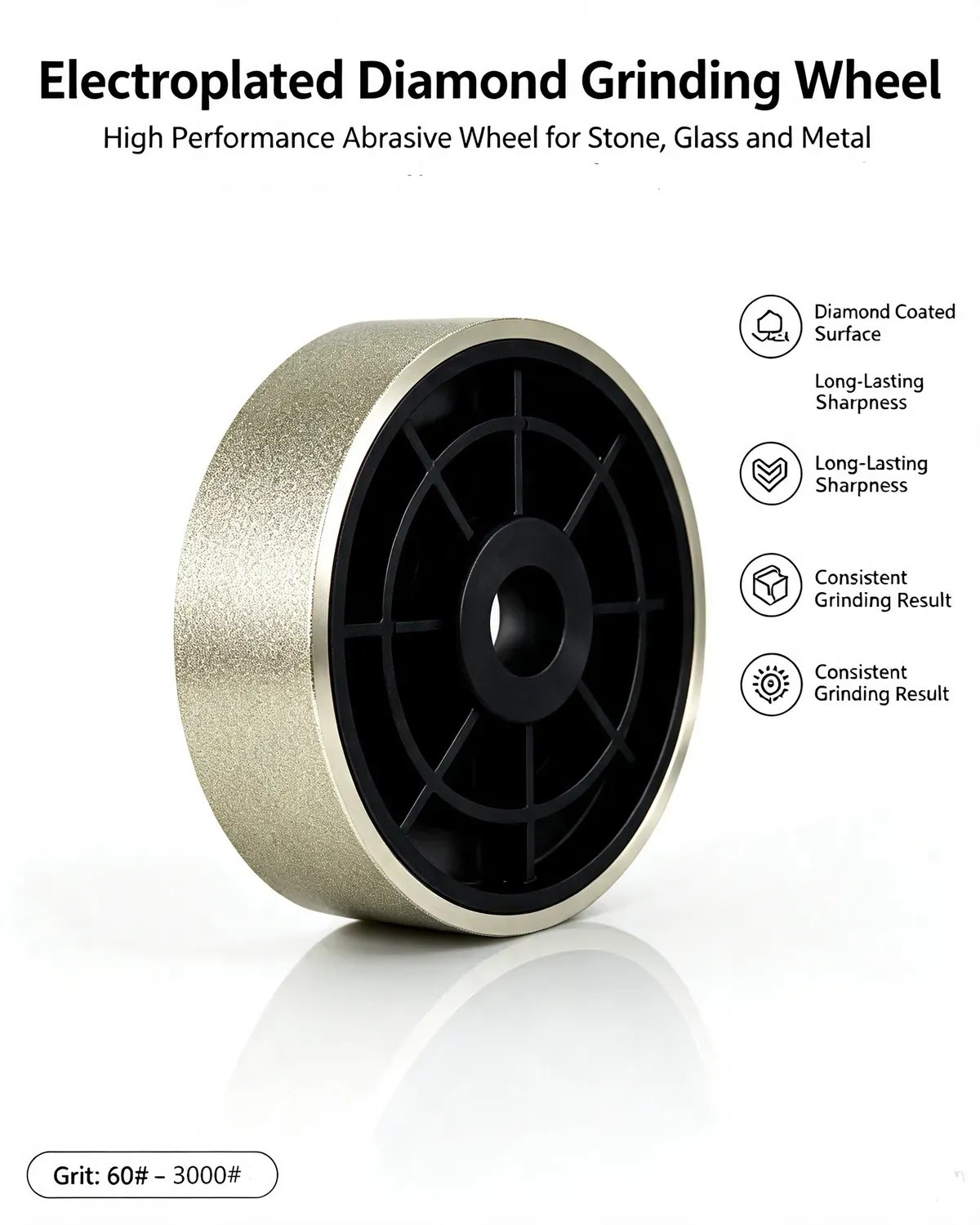
This comparison breaks down electroplated vs bonded diamond tools on cost, tool life, cut quality and failure mode, then gives you a simple rule for when to use each.
What “electroplated” and “bonded” actually mean
Electroplated diamond tools are made by plating a single layer of diamond onto a steel body using nickel. The diamond sits proud of the surface, fully exposed, held by a thin nickel matrix. When the layer wears through, the tool is done — it cannot be re-dressed.
Bonded diamond tools (resin, metal or vitrified bond) bury diamond throughout a thick abrasive layer. As the bond wears back, fresh diamond is exposed, so the tool keeps cutting and can usually be dressed or trued to restore form. This is the core of the electroplated vs bonded diamond tools decision.
Cost: upfront price vs cost per part
Electroplated tools are usually cheaper per piece and can be made in almost any profile, which makes them attractive for low-volume and complex-form work. Bonded tools cost more upfront because there is far more diamond and a more complex manufacturing process.
The comparison flips on volume. A bonded tool’s cost per part falls as it keeps cutting, while an electroplated tool’s cost per part is fixed — when the single layer is gone, you buy a new one. For high-volume production, bonded diamond tools almost always win on total cost, even though the sticker price is higher.
Tool life: single layer vs renewable layer
- Electroplated: one thin layer of diamond. Life is predictable but finite, and the tool is disposable. Excellent consistency from tool to tool.
- Bonded: a deep layer of diamond that renews as it wears. Life can be many times longer, and the tool can be dressed back into specification for a second and third life.
Where an electroplated tool gives repeatable performance across a batch, a bonded tool gives repeatable performance across a production run.
Cut quality and heat are where the electroplated vs bonded diamond tools trade-off shows up most clearly.
Cut quality and heat
Electroplated tools cut aggressively with a single sharp layer and run cool because the exposed diamond clears swarf well. They are ideal for free-cutting and for heat-sensitive work where you want minimal bond rubbing.
Bonded tools trade some free-cutting for form stability and finish consistency. Metal-bond wheels hold profile tightly for form grinding, while resin-bond wheels run cooler for delicate edges. If surface integrity is the priority, choose the bond that matches your specification rather than the generic cheapest option.
When to choose electroplated diamond tools
- Complex or one-off profiles where a plated form is cheapest to produce.
- Low-to-medium volume jobs where the tool will not wear out before the job ends.
- Free-cutting, heat-sensitive operations such as fine deburring and hand-held work.
- When you want consistent, predictable performance without a dressing routine.
When to choose bonded diamond tools
- High-volume production where cost per part, not tool price, is what matters.
- Form grinding that must hold a precise profile across thousands of parts.
- Jobs where you need the ability to dress and re-true the tool.
- Precision finishing where surface integrity and repeatability are critical.
Matching electroplated vs bonded diamond tools to your operation
For a sharp, free-cutting single layer, our electroplated diamond grinding wheel covers aggressive profiling and finishing. Where form holding matters more than free cutting, a metal-bonded diamond dressing wheel holds profile far longer. For flat polishing and gem work, an electroplated diamond disc offers low cost per piece with predictable life.
Frequently asked questions about electroplated vs bonded diamond tools
Are electroplated diamond tools worse than bonded tools?
Neither is better in the abstract. Electroplated tools win on upfront cost, complex profiles and free cutting; bonded tools win on tool life, cost per part and the ability to be re-dressed.
Can electroplated diamond tools be re-sharpened?
Generally no. The single plated layer cannot be restored once worn, so an electroplated tool is effectively disposable. Bonded tools can often be dressed and reused.
Which lasts longer for production grinding?
Bonded tools, almost always. Their renewable diamond layer means life is measured in production runs rather than single jobs, which is why high-volume shops standardise on bonded tooling.
Framing the electroplated vs bonded diamond tools choice around cost per part, not purchase price, is the single most useful habit a buyer can build.
Weighed this way, electroplated vs bonded diamond tools stops being a guess and becomes a repeatable buying rule.
Final thoughts
The electroplated vs bonded diamond tools question is really a question about volume and form. Reach for electroplated when you need a sharp, cheap, complex profile for a finite job; reach for bonded when you need long life, form holding and a low cost per part. For more on bond behaviour see our guide on resin vs metal bond diamond wheels, and for tool selection across superabrasives read diamond and CBN tools. Background on the plating process is available from Wikipedia.