

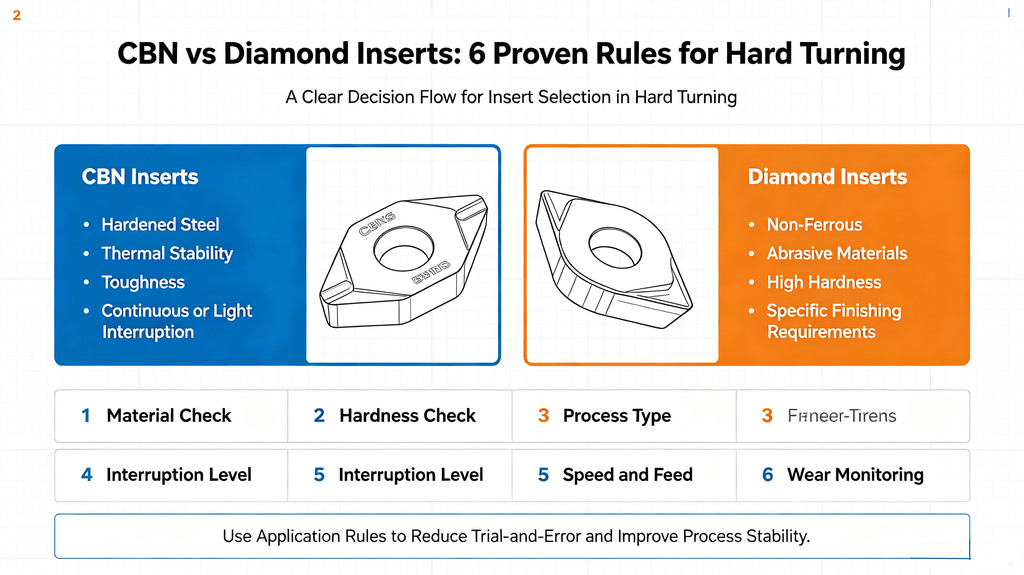
Choosing between CBN and diamond inserts (the CBN vs diamond inserts question every shop faces) is the single decision that decides whether hard turning pays off. Both are superhard, both cut hardened steel, and both cost far more than carbide. But they behave very differently, and using the wrong one wastes money fast. These six rules tell you which to reach for.
Rule 1: CBN vs diamond inserts – match the tool to the workpiece
Diamond is the hardest material, but it reacts with iron at high temperature. That means a diamond insert wears away quickly on steel and cast iron. CBN (cubic boron nitride) is second only to diamond in hardness and is chemically stable against ferrous metals, which makes it the default choice for hardened steel. So the first rule is simple: steel and iron go to CBN, non-ferrous and non-metallic go to diamond.
Rule 2: CBN vs diamond inserts – use diamond for non-ferrous materials
Diamond inserts and PCD inserts are unbeatable on aluminium, copper, brass, composites, carbon fibre, ceramics, glass and hard rubber. Where CBN would be wasted on hard steel, diamond turns those materials with mirror finishes and near-zero wear. This is where a diamond insert earns its price.
Rule 3: Check hardness before you commit
CBN inserts cut hardened steel from about 45 HRC up to 68 HRC, exactly the range where carbide fails and grinding is slow. If the part is under 45 HRC, coated carbide is usually cheaper and good enough. Above 45 HRC, CBN turning replaces grinding and cuts cycle time dramatically.
Rule 4: CBN vs diamond inserts – think cost per part, not cost per insert
A CBN or diamond insert costs many times more than carbide, but it also lasts many times longer and holds tolerance without constant offsets. Run the numbers over a batch: fewer tool changes, less scrap and no grinding step often make the superhard insert the cheaper option per finished part.
Rule 5: Respect the cutting conditions
Whatever the comparison, both families hate interrupted cuts and chatter. Keep the setup rigid, use a stable depth of cut and never let the tool dwell. For CBN on hardened steel, moderate speed with a firm, continuous feed gives the best edge life. Add coolant or high-pressure air to control the heat at the edge.
Rule 6: Choose the right grade and geometry
Within each family, grade and edge preparation matter as much as the material. A honed edge resists chipping on interrupted cuts; a sharp edge cuts cleaner on continuous turning. Match the grade to the hardness and the geometry to the operation, and the insert will deliver its full life.
CBN vs diamond inserts: quick comparison
- Hardened steel and cast iron: CBN
- Aluminium, copper, composites, ceramics: diamond / PCD
- Below 45 HRC: coated carbide is often enough
- 45-68 HRC: CBN replaces grinding
- Cost: judge per finished part, not per insert
CDFIT cutting tools for hard turning
CDFIT supplies triangle CBN coated TNGA inserts for external turning and PCD diamond rhombus CNC turning inserts for non-ferrous work. If you machine both steel and aluminium, pairing the two covers the full shop floor.
For background on cubic boron nitride and why it suits hardened steel, see the Wikipedia reference on cubic boron nitride (CBN).
Frequently asked questions
Can I use a diamond insert on steel in the CBN vs diamond inserts decision?
No. Diamond reacts with iron at cutting temperature and wears rapidly. Use CBN for steel and iron, and save diamond for non-ferrous and non-metallic materials.
In the CBN vs diamond inserts choice, is CBN better than grinding for hardened steel?
For many parts, yes. CBN hard turning removes the grinding step, holds tight tolerance and cuts cycle time, as long as the machine is rigid and the part is above about 45 HRC.
Which lasts longer, CBN or diamond?
On the material each is designed for, both last far longer than carbide. Diamond is harder but only durable on non-ferrous work; CBN wins on steel and iron.
Not sure which insert suits your material? Send CDFIT your workpiece, hardness and operation and we will recommend the right grade.