

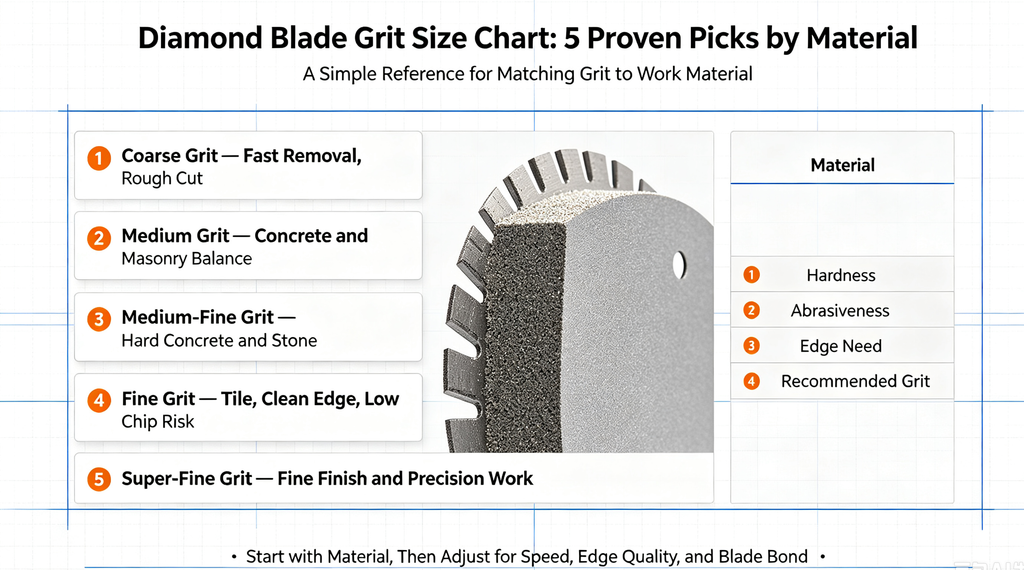
Diamond blade grit size is the number buyers notice last and technicians argue about first. Get it wrong and a blade that should slice through tile will chip it, or a blade that should leave a polished edge will burn the surface. This chart turns grit size into a simple material decision.
What diamond blade grit size actually means
Diamond blade grit size describes the diamond particles bonded to the blade rim. A coarse grit has large, widely spaced diamond that clears material fast and leaves a rougher edge. A fine grit has small, dense diamond that cuts slower and leaves a smoother finish. Coarse equals speed; fine equals finish. The blade also carries a bond, the metal matrix that holds the diamond, and bond hardness works with grit to set how the blade performs.
Diamond blade grit size chart by material
- Concrete, asphalt, masonry: coarse (16-30 grit) for fast cutting and easy swarf removal
- Porcelain and ceramic tile: fine (60-120 grit) to cut clean edges with minimal chipping
- Marble and soft stone: medium (36-60 grit) for a balance of speed and finish
- Granite and hard stone: fine (60-100 grit) with a soft bond to keep the diamond exposed
- Glass and semiconductor: very fine, on ultra-thin blades for precision cuts without micro-cracks
1. Start from the material, then set the diamond blade grit size
Name the material first, then read the grit. Hard, brittle materials like porcelain and granite need fine grit and a soft bond so the blade stays sharp and the edge stays clean. Soft, abrasive materials like green concrete and asphalt need coarse grit and a hard bond that resists wear.
2. Read the bond with the grit
Grit sets the finish; the bond sets the life. A hard bond holds diamond longer and suits abrasive material. A soft bond wears back to expose fresh diamond and suits hard material. A fine grit on a hard bond will glaze and stop cutting; a coarse grit on a soft bond will wear out early. Match both.
3. Balance cut speed against edge quality
If the job is volume cutting, move to a coarser diamond blade grit size and cut faster. If the job is a visible edge, move finer and slower. For mixed jobs, a medium grit with a matched bond covers the widest range without a blade change.
4. Let the blade cut, do not force it
Excessive feed pressure overheats the rim, glazes the diamond and shortens blade life, whatever the grit. Run the blade at its rated speed with steady feed and enough water or cooling. A blade that stops cutting is usually glazed, not worn out.
5. Match grit to the machine and RPM
Every blade has a maximum RPM. A fine-grit precision blade and a coarse-grit demolition blade are built for different spindle speeds. Always check the blade rating against the tool before you mount it.
CDFIT blades and stone tools
CDFIT makes blades across the grit range, from TCT coated circular saw blades and nitride-coated diamond saw blades to ultra-thin diamond saw blades for gem and semiconductor work. Tell us the material and finish you need and we match the grit and bond.
For background on how diamond abrasives are graded, see the Wikipedia page on grit size.
Frequently asked questions
What grit is best for cutting tile?
Fine grit, around 60-120, cuts porcelain and ceramic cleanly with minimal chipping. Coarser grits cut faster but chip the glaze.
Does a finer diamond blade cut slower?
Yes. Fine grit removes less material per pass but leaves a smoother edge. Choose it when finish matters more than speed.
Why does my diamond blade stop cutting?
Most often the diamond has glazed. The fix is usually a softer bond or a coarser grit for the material, plus less feed pressure and more cooling.
Need the right grit for your material? Send CDFIT your material and finish requirement and we will recommend the blade.