

The CBN vs diamond grinding wheels question comes up on almost every hardened-steel job. Both are superabrasives, both cut materials that conventional wheels cannot touch, and both cost far more than aluminum oxide. But they are not interchangeable, and choosing wrong can destroy a wheel in a single shift.
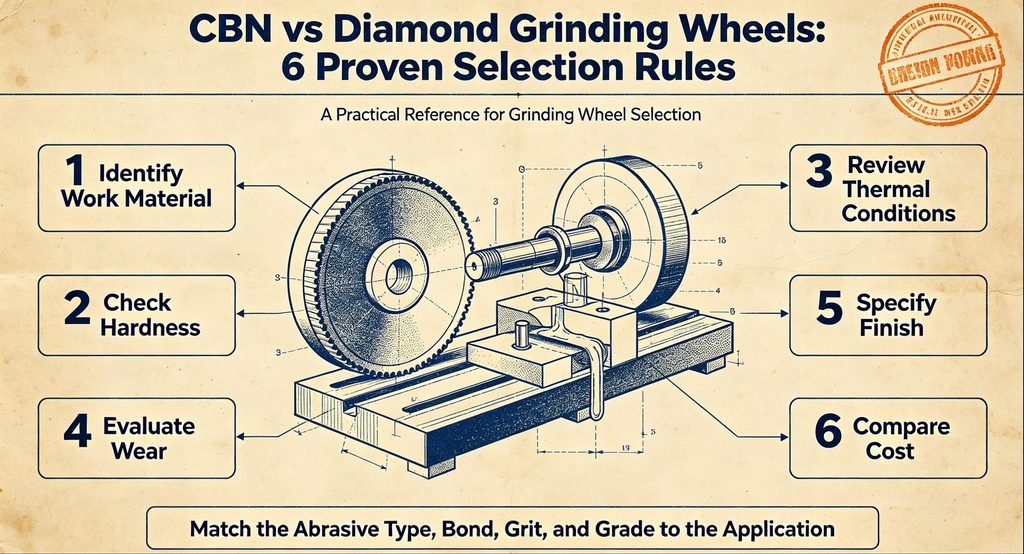
This guide explains the real differences, then gives you six rules for picking the right one.
The Short Answer
Use diamond for non-ferrous and non-metallic work: carbide, ceramics, glass, PCD, stone, and composites. Use CBN for ferrous and high-temperature alloys: hardened tool steel, HSS, die steel, Inconel, and other nickel or cobalt alloys.
The deciding factor is chemistry, not hardness. Diamond is harder than CBN, but diamond reacts with iron at grinding temperatures and wears away fast. CBN is chemically stable against iron, so it holds up where diamond fails.
Why Hardness Alone Misleads You
Diamond sits at roughly 10 on the Mohs scale and CBN at about 9.5. On paper diamond wins. In practice, a diamond wheel grinding hardened steel will glaze and wear at several times the rate of a CBN wheel doing the same job.
The reason is that iron acts as a catalyst. At the temperatures generated in a grinding zone, iron pulls carbon out of the diamond lattice and converts the surface back into graphite or iron carbide. The diamond particles dull from the inside out. CBN has no such reaction, so its particles stay sharp until they are mechanically worn instead of chemically eaten.
The CBN vs Diamond Comparison Table
| Factor | Diamond | CBN |
|---|---|---|
| Hardness | ~10 Mohs (hardest) | ~9.5 Mohs |
| Best workpiece | Carbide, ceramic, glass, PCD, stone, composites | Hardened steel, HSS, die steel, superalloys |
| Reaction with iron | Yes – carbon diffuses into iron at high temperature | No – chemically stable against iron |
| Thermal limit | Graphitizes above roughly 700 C in air | Stable to much higher temperatures |
| Typical bond | Resin, metal, vitrified, electroplated | Resin, vitrified, metal, electroplated |
| Relative cost | Higher for comparable grit | Often lower for steel work |
The CBN vs diamond grinding wheels question comes up the moment a shop starts cutting hardened steel.
Rule 1: Decide by Workpiece Chemistry First
Before you look at grit, speed, or price, ask one question: does the workpiece contain iron? If the answer is yes, default to CBN. If the answer is no, diamond is usually the better and sometimes the only choice.
Borderline cases exist. Some tool steels are ground successfully with diamond when the grinding zone stays cool and the wheel is dressed often, but this is the exception. Our guide to diamond and CBN grinding wheels covers those edge cases in detail.
Rule 2: Let Heat Drive the Decision
Keep the CBN vs diamond grinding wheels comparison in mind here: the same heat that makes CBN efficient makes diamond fail faster.
The harder you push the cut, the hotter the grinding zone gets, and the more diamond suffers. If your process runs high wheel speeds with deep passes, the chemistry penalty on diamond grows. This is why high-productivity steel grinding almost always lands on CBN, even though diamond is harder.
If you must use diamond on a ferrous part because of an unusual geometry, keep the cut light, the coolant flooding, and the wheel freshly dressed. Never let a diamond wheel sit in a hot cut.
Cost aside, the CBN vs diamond grinding wheels decision is really about the workpiece chemistry.
Rule 3: Match the Bond to the Abrasive
CBN vs diamond grinding wheels is the first fork in the road for any hardened-steel job.
CBN wheels generally pair well with vitrified and resin bonds for steel, and metal bonds for superalloys. Diamond wheels favor resin, metal, and electroplated bonds. The bond controls how the wheel self-sharpens, so the wrong pairing will glaze or shed abrasive prematurely.
For a deeper look at bond behavior, see our comparison of resin and metal bond wheels.
Rule 4: Do Not Substitute One for the Other Mid-Process
Most CBN vs diamond grinding wheels mistakes trace back to a substitution made to save money on a single wheel.
Switching from CBN to diamond partway through a steel job is a common cost-saving mistake. The diamond wheel wears rapidly, the finish changes, and the process window you tuned is gone. Choose the abrasive at the process planning stage and keep it stable.
The one legitimate switch is moving from diamond to CBN when you discover the part is ferrous. Make that change at a roughing step, not during finishing.
Whatever the CBN vs diamond grinding wheels comparison says, test the wheel on your own machine first.
Rule 5: Factor Cost Per Part, Not Cost Per Wheel
A CBN wheel often costs more upfront than a comparable diamond wheel, yet delivers a much lower cost per part on steel because it lasts many times longer. Compare the two on total cost: wheel life, dressing frequency, cycle time, scrap rate, and coolant consumption. The cheapest wheel is rarely the cheapest process.
Rule 6: Tune Grit and Speed for the Abrasive
Speed and grit interact, so treat the CBN vs diamond grinding wheels choice as one decision, not two.
CBN tolerates higher wheel speeds than diamond on steel, because it does not graphitize. That lets you raise speed without the chemical penalty and gain removal rate. Diamond on non-ferrous work prefers moderate speeds and generous coolant.
Grit selection follows the same logic in both cases. Start with our diamond grinding wheel grit chart rules and apply them to the abrasive you chose.
Frequently Asked Questions
Can I grind hardened steel with a diamond wheel?
You can, briefly, but wear rates are high and finish is unstable. For any production volume, CBN is the correct choice.
Is CBN harder than diamond?
No. Diamond is harder. CBN wins on steel because of chemistry, not hardness.
Which lasts longer?
On steel, CBN lasts far longer. On carbide, ceramic, or glass, diamond lasts longer. Match the abrasive to the material.
Are CBN and diamond wheels interchangeable on the same machine?
Usually yes, with a speed and coolant review. Check the wheel’s maximum RPM and the bond’s coolant compatibility before mounting.
Source the Right Superabrasive Wheel
Whether the answer is CBN or diamond, CDFIT manufactures both. Look at our electroplated diamond grinding wheel for non-ferrous work, and our vitrified bond cup grinding wheel for precision finishing. Not sure which chemistry fits your steel? Send us the workpiece and we will recommend the abrasive, grit, and bond.
Standards and Further Reading
Both abrasives are covered by ISO superabrasive standards, and the Wikipedia CBN entry explains why CBN holds up where diamond does not. Read those before you lock in a specification.
Get the Right Wheel for Your Job
CDFIT manufactures both diamond and CBN grinding wheels with controlled particle distribution and consistent bond hardness. Tell us your workpiece material, hardness, finish requirement, and machine details, and we will recommend the abrasive, grit, and bond that keeps your cost per part low.