

Diamond grinding wheel concentration is the single most misunderstood number on a wheel spec sheet. Most buyers compare grit, bond and size and completely ignore concentration — then wonder why one wheel cuts fast and wears out, while another glazes and burns the part. If you want consistent results, you need to understand what concentration actually controls.
Quick Answer: Diamond Grinding Wheel Concentration
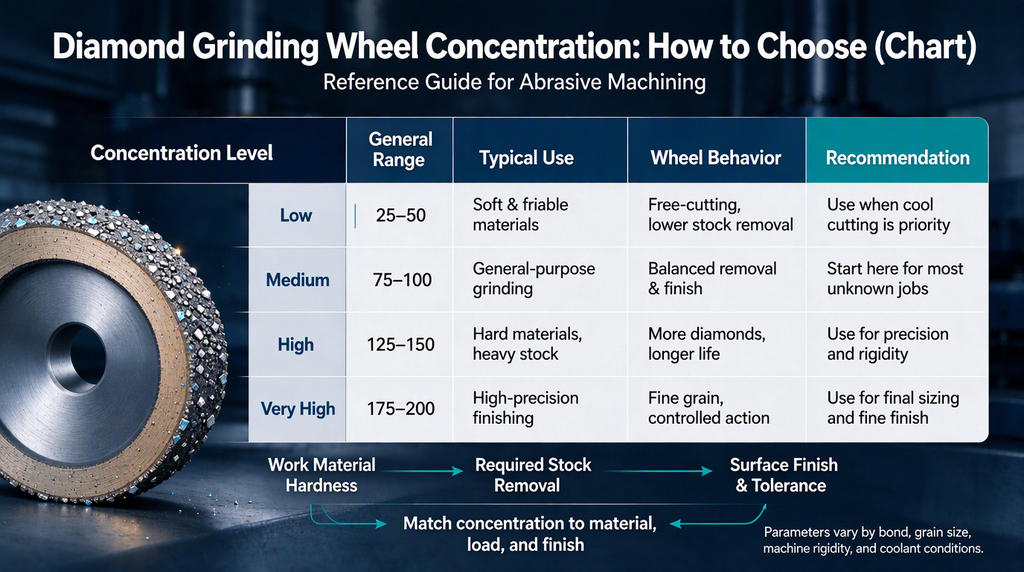
If you only need the short answer: use 100 concentration for general diamond grinding wheel concentration work, drop to 75 for soft or gummy materials, and rise to 125–150 for hard, form-holding jobs. Diamond grinding wheel concentration is the best single lever for wheel life when grit is already correct.
For an external reference on superabrasive specification, see the ASM International materials database, which documents grinding practice across materials.
This guide explains what diamond concentration means, how it is measured, and how to pick the right value for your material, machine and finish. Diamond grinding wheel concentration decides how much superabrasive sits in the bond, and that single choice drives wheel life, cutting speed and surface finish.
What Is Diamond Grinding Wheel Concentration?
Concentration is the amount of diamond (by volume) in the abrasive layer, expressed as a multiple of 100. In the industry, 100 concentration equals 4.4 carats of diamond per cubic centimetre of abrasive layer. So a 100-concentration wheel holds 4.4 ct/cm³, a 125-concentration wheel holds 5.5 ct/cm³, and a 150-concentration wheel holds 6.6 ct/cm³.
The common values you will see are 50, 75, 100, 125, 150 and 200. Higher concentration means more diamond points doing the cutting, but also a higher price and a stiffer, less forgiving wheel.
How Concentration Differs from Grit Size
Grit size and concentration are not the same thing, and mixing them up is the most common specification error.
- Grit size controls the size of each individual diamond crystal. Coarse grit removes material fast and leaves a rougher finish; fine grit leaves a smoother finish but cuts slower.
- Concentration controls how many crystals are packed into the bond. It affects wheel life, load per crystal and heat, but not the scratch depth of a single grain.
You can run a fine grit at high concentration for a mirror finish with good life, or a coarse grit at low concentration for free cutting on soft, gummy materials.
Why Concentration Matters More Than You Think
When concentration is too low for the job, each diamond grain carries more load. The grains fracture early, the bond wears unevenly, and the wheel loses form. When concentration is too high, the bond becomes hard to dress, the wheel glazes, and the grinding zone overheats.
The right concentration balances three goals: keep each grain lightly loaded, allow the bond to wear enough to expose fresh grit, and hold form without constant dressing.
Choosing Concentration by Application
Low concentration (50–75)
Best for soft, gummy or highly ductile materials where chip clearance matters more than form holding. Free-cutting on stainless steel and aluminium, and for light surface grinding where heat is the enemy.
Medium concentration (100–125)
The workhorse range for most carbide tool grinding, ceramics and general precision grinding. If you are unsure, 100 is the safe starting point for a diamond grinding wheel.
High concentration (150–200)
Used for form grinding, hard-to-dress profiles, and applications that must hold tight tolerances over long runs. Also common when grinding superhard ceramics and PCD/PCBN tool edges.
| Concentration | Diamond (ct/cm³) | Best For |
|---|---|---|
| 50 | 2.2 | Soft, gummy materials; free cutting |
| 75 | 3.3 | Stainless steel, light surface grinding |
| 100 | 4.4 | General precision grinding (default) |
| 125 | 5.5 | Carbide tool grinding, ceramics |
| 150 | 6.6 | Form grinding, tight tolerances |
| 200 | 8.8 | Superhard materials, long production runs |
How Concentration Interacts With Bond Hardness
Concentration and bond hardness work together. A high concentration with a soft bond can shed grit too quickly; a high concentration with a hard bond glazes and burns. When you increase concentration, you often need to soften the bond slightly to keep the wheel self-sharpening.
If you are fighting burn or glazing, do not only change grit — review concentration and bond together. Our diamond grinding wheel troubleshooting guide walks through the symptoms and fixes in detail.
Practical Starting Points
- Carbide tool grinding: 100–125 concentration, resin bond.
- Ceramic and glass: 100–150 concentration with a soft-to-medium bond.
- Superhard PCD/PCBN edges: 150–200 concentration.
- Heat-sensitive stainless: 75–100 concentration, free-cutting bond.
When in doubt, start at 100 and adjust from the wear pattern. A wheel that loads is usually too hard or too high in concentration for the material; a wheel that wears too fast is usually too soft or too low.
Matching Concentration to Your Machine
Rigid, high-power machines tolerate higher concentration because they can push the wheel without chatter. Lighter machines and manual grinders do better with medium concentration and a free-cutting bond, because they cannot generate the force a hard, dense wheel needs to stay sharp.
Reading Wear to Fine-Tune Concentration
The wheel tells you whether concentration is right by how it wears. Check the cutting edge after each run and read the pattern:
- Rounded, shiny grains and a glazed face: concentration is too high, the bond is too hard, or the wheel is not being dressed often enough. Excess grains are rubbing instead of cutting.
- Rapid radial wear with exposed, sharp grains: concentration is too low or the bond is too soft. Each grain is overloaded and pulled out early.
- Uneven wear and lost form: concentration is too low for the tolerance you need, or the wheel is too soft for a form-holding job.
- Steady, even wear with a slightly open face: concentration is right. The bond erodes just fast enough to expose fresh diamond without shedding it prematurely.
Keep a simple log of concentration, bond, speed and result for each material you grind. After a few jobs you will have a reliable starting point for anything new.
Cost, Life and Value
Concentration raises the wheel price directly, because diamond is the most expensive ingredient. A 150-concentration wheel can cost far more than a 100 wheel of the same size. But price per wheel is not the number that matters.
What matters is cost per part ground. A higher-concentration wheel that holds form and needs fewer dressing stops can produce far more parts before it is worn out, which often makes it cheaper overall on production work. On light or one-off jobs, a cheaper medium-concentration wheel is usually the better value.
Storing and Handling Diamond Wheels
Diamond wheels are precision tools and deserve careful handling. Store them upright on a padded surface, keep them away from moisture and shock, and never drop a wheel on its edge. A chipped or cracked bond will throw the wheel out of balance and ruin concentricity. Before mounting, check the flange and spindle for runout, and always respect the maximum operating speed marked on the wheel.
Frequently Asked Questions
Is higher concentration always better?
No. Higher concentration costs more and can glaze if your machine or bond cannot support it. Match concentration to material, machine rigidity and finish target.
Can I increase concentration without changing grit?
Yes. Concentration and grit are independent. You can keep the same grit and raise concentration to improve life and form holding.
Next Steps
Concentration is one of four specs — grit, bond, concentration and size — that decide how a wheel performs. Get all four right and diamond grinding becomes predictable. If you are choosing a wheel for a specific material, review our diamond grinding wheel selection guide, or browse our diamond grinding tools and send us your specification for a matching recommendation.
For more detail on the other specifications, see how to choose the right diamond grit and resin vs metal bond diamond wheels. If you grind ferrous metals, also read our CBN vs diamond grinding wheels comparison before you specify.