

A diamond grinding wheel grit chart turns a confusing number into a simple decision. Grit size controls how fast a wheel cuts, how smooth the finish looks, and how long the wheel lasts before it needs dressing. Pick the wrong grit and you either burn the workpiece or waste hours chasing a mirror finish that never arrives.
This guide gives you a practical grit chart, the six rules we use on the shop floor, and the mistakes that cost the most time.
Why Grit Size Matters More Than Wheel Hardness
Grit size is the physical size of the diamond particles bonded into the wheel. A 120-grit wheel holds coarser particles than a 400-grit wheel. Those particles act like thousands of tiny cutting tools, so their size sets the ceiling on surface finish and the floor on material removal rate.
Wheel hardness controls how firmly the bond holds those particles. You can adjust hardness to tune how the wheel self-sharpens, but you cannot make a 400-grit wheel remove metal like a 120-grit wheel. Grit is the primary decision; hardness is the tuning knob.
Diamond Grinding Wheel Grit Chart
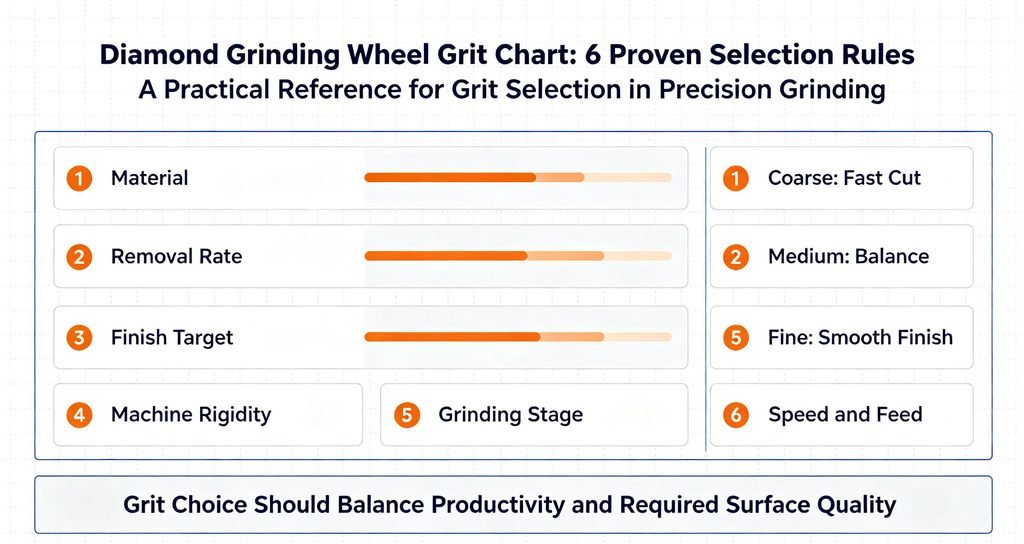
Use this table as your starting point for diamond and CBN wheels. The “typical finish” column assumes a rigid machine, proper coolant, and a dressed wheel.
| Grit | Average particle size | Typical use | Typical finish (Ra) |
|---|---|---|---|
| 60 / 80 | ~180-250 um | Heavy stock removal, roughing carbide | 1.6-3.2 um |
| 100 / 120 | ~125-150 um | General roughing to semi-finish | 0.8-1.6 um |
| 150 / 180 | ~80-100 um | Semi-finish, mixed production | 0.4-0.8 um |
| 220 / 240 | ~60-70 um | Finishing, tool resharpening | 0.2-0.4 um |
| 320 | ~40-50 um | Fine finishing, PCD and PCBN edges | 0.1-0.2 um |
| 400-600 | ~20-30 um | Polishing, mirror finish on inserts | 0.05-0.1 um |
Two cautions. First, particle-size ranges differ slightly between suppliers, so always verify against the manufacturer’s own chart. Second, the finish numbers assume you are not fighting chatter, a soft bond, or a worn spindle – any of those will ruin the finish no matter what grit you choose.
A diamond grinding wheel grit chart only pays off when it matches your material and finish spec.
A diamond grinding wheel grit chart is only useful if you read it against your material, not in isolation.
Rule 1: Match Grit to the Finish, Not the Material
Beginners choose grit by material, which is backwards. Start from the surface finish (Ra) the drawing calls for, then walk back up the chart until you find the coarsest grit that still holds that finish reliably.
Coarser grits cut cooler and faster, so choosing the coarsest grit that meets the spec is almost always the most productive and longest-lasting choice. Jumping straight to a 400-grit wheel to be “safe” is the single most common cause of slow cycle times.
For a deeper look at how grit selection feeds into surface quality, see our guide to choosing diamond grit.
Rule 2: Go One Grit Coarser for Hard-to-Grind Materials
Read the grit chart above again with hard materials in mind – the diamond grinding wheel grit chart numbers shift one step coarser when the workpiece gets tougher.
Harder workpieces dull the abrasive faster. When you move from a soft steel to a carbide, ceramic, or hardened tool steel, drop one grit step coarser than the chart suggests. The wheel cuts more freely and generates less heat, which protects both the workpiece and the bond.
For extremely hard materials, CBN wheels often beat diamond because diamond reacts with iron at high temperature. The grit chart above still applies, but the abrasive type changes.
Cross-check every row of the diamond grinding wheel grit chart against the finish your customer actually specified.
Rule 3: Do Not Skip a Full Grit Step
Grinding is a sequence of removing scratches. A 120-grit wheel leaves scratches about 125 um deep, and a 400-grit wheel cannot remove those scratches in one pass – it just polishes the tops of them. You need a full grit step in between (for example 120 then 240 then 400) to erase the previous layer.
Skipping a step does not save time. It doubles the passes needed at the next grit and usually leaves visible scratch patterns that fail inspection.
Rule 4: Watch the Wheel, Not the Clock
A grit chart tells you where to start; the wheel tells you whether you got it right. Treat the diamond grinding wheel grit chart as a hypothesis and the wheel face as the test result.
A correctly matched grit self-sharpens – dull diamond particles break out and fresh ones appear. The signs that you have gone too fine for the application are:
- Glazing: the wheel face looks shiny and refuses to cut
- Loading: material smears into the pores instead of clearing
- Burning: blue or brown discoloration on the workpiece
- Heat rise with no drop in the finish quality
Any of these means the grit is too fine for the material or the bond is too hard. Step back one grit before you need to dress the wheel again. Our troubleshooting guide covers fixes for each symptom.
Keep the diamond grinding wheel grit chart on the shop floor – grit choices get repeated, and so do the mistakes.
Rule 5: Match Bond Type to the Grit
Fine grits need a softer, more porous bond so the cut stays cool and chips clear. Coarse grits tolerate harder, denser bonds because the large particles have room to clear swarf. When you change grit, re-check the bond – a 400-grit wheel bonded as hard as a 100-grit roughing wheel will glaze in minutes.
See our comparison of resin and metal bond diamond wheels for the trade-offs.
Rule 6: Verify with a Test Cut Before the Production Run
Once you have your number, write it down. A shop that records its own diamond grinding wheel grit chart choices gets repeatable results; a shop that guesses every time does not.
Even the cleanest grit chart is a starting point. Run a single test part at your chosen grit, measure the finish, and inspect for burn or chatter. Adjust one variable at a time – grit first, then bond hardness, then wheel speed – so you can attribute the change to a single cause.
Record the grit, bond, speed, feed, and coolant for every job. Within a few months you will have your own internal grit chart, which beats any generic table.
Frequently Asked Questions
What grit diamond grinding wheel should I use for carbide?
For general carbide roughing to semi-finish, start at 100 to 150 grit. Move to 220-400 grit only when the drawing calls for a fine finish or a sharp cutting edge.
Can I use one grit for both roughing and finishing?
You can, but it costs time. A single mid-range grit forces you to run slower for the finish and lighter than ideal for roughing. Two grits (coarse then finish) almost always beat one compromise grit.
Does a finer grit give a better finish automatically?
No. Chatter, an unbalanced wheel, or a worn spindle will wreck the finish at any grit. Fix the machine and the setup before you spend money on finer wheels.
How often should I dress a fine-grit wheel?
Dress when you see glazing or loading, not on a fixed schedule. Fine grits load faster, so expect more frequent light dressings than with coarse roughing wheels.
Shop Diamond Grinding Wheels by Grit
Ready to put this chart to work? Browse our resin bond diamond grinding wheels for fine finishing, or step up to the ceramic and resin bond diamond grinding wheel when you need tighter tolerances. If your wheel is already glazing, the fix is usually dressing – see our dressing guide – or one grit coarser above.
Standards and Further Reading
Grit designations follow FEPA and ANSI conventions – see the FEPA abrasives standards for the official grit ranges. If you are new to superabrasives, the Wikipedia grinding wheel overview is a quick way to get the vocabulary straight before you specify a wheel.
Choosing the Right Supplier
A grit chart is only as good as the wheel behind it. CDFIT manufactures diamond and CBN grinding wheels with consistent particle distribution and bond hardness batch to batch, so the grit you order behaves the same every time. Send us your material, finish requirement, and machine details and we will recommend the grit and bond combination for your job.