

A diamond wire saw for concrete cutting is the fastest way to cut through reinforced walls, foundations and bridge decks where a blade cannot reach. Unlike a circular saw that must spin a rigid disc, a wire saw pulls a loop of diamond-beaded wire through the concrete, so it cuts any depth and any shape. This guide covers the setup variables that decide whether the cut runs smooth or the wire snaps.
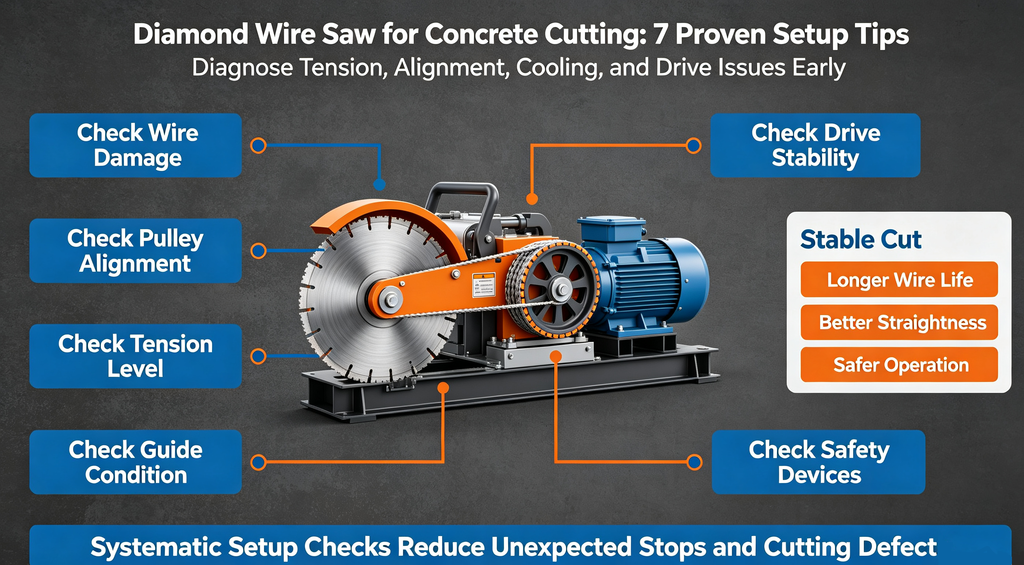
Why choose a diamond wire saw for concrete
A wire saw solves the two problems a blade cannot: depth and geometry. A 400 mm blade reaches about 150 mm; a wire saw cuts a 1,200 mm wall in a single pass because the wire wraps around the structure. It also cuts flush to a corner, makes square openings for doors and windows, and runs quietly compared with hydraulic wall saws. For demolition contractors, that flexibility saves hours of coring and stitch drilling.
1. Match wire speed for a diamond wire saw for concrete
Wire speed is the first variable to set. Soft, green concrete likes a higher surface speed (around 25-30 m/s) so the beads stay free-cutting. Hard, high-strength or heavily reinforced concrete needs a lower speed (18-22 m/s) to keep the diamond sharp and avoid glazing. If the wire starts to bow or the cut slows, reduce speed before you add tension.
2. Keep water flow constant
A diamond wire saw for concrete is a wet process. Water flushes the slurry out of the kerf, cools the beads and stops the segments from glazing. Aim for a steady, visible flow at both entry and exit points. If the water turns to a thick paste, you are starving the cut and the beads will polish instead of grind.
3. Set bead spacing for the cut
On a diamond wire saw for concrete, bead spacing controls how aggressively the wire bites. Close spacing gives a smoother, straighter kerf and longer bead life, but cuts slower. Wider spacing clears swarf faster and suits soft, abrasive concrete. Pair the wire to the job: dense beads for precision openings, open beads for bulk demolition.
4. Tension, not force
On any diamond wire saw for concrete, the wire should be tight enough to run straight but never so tight that it stretches or snaps. Let the diamond do the work. Pushing the machine harder raises friction, overheats the beads and shortens wire life. Feed rate should follow the cut, not lead it.
5. Choose the right bead bond for a diamond wire saw for concrete
Bond hardness must match the concrete. Hard bond beads (for soft, abrasive concrete) hold the diamond longer and stop premature wear. Soft bond beads (for hard, dense concrete) expose fresh diamond continuously so the wire keeps cutting. The wrong bond is the number one cause of a wire that “stops cutting” halfway through a job.
6. Plan the water and slurry removal
With a diamond wire saw for concrete, the slurry is heavy and alkaline. Set up a collection point, a slurry vacuum or a settling pit before you start. A controlled site keeps the wire saw running and protects the operator from slip and caustic exposure.
7. Inspect beads before every pass
Check bead wear, wire kinks and connector crimps on the diamond wire saw for concrete at the start of each cut. A single loose bead can jam the kerf and break the wire. Rotate the wire regularly so wear spreads evenly and you get full life from every bead.
Cutting parameters at a glance
- Wire speed: 18-22 m/s hard concrete, 25-30 m/s soft concrete
- Water: constant flow, clear at both ends of the kerf
- Feed rate: let diamond cut, never force the wire
- Bond: hard bond for abrasive concrete, soft bond for dense concrete
- Tension: straight-running, not stretched
Which wire saw tools does CDFIT supply?
CDFIT manufactures diamond wire rope saws for concrete demolition, plus the drilling and cutting tools that support the same jobs: hollow core diamond drill bits for glass and ceramic and ultra-thin diamond saw blades for gem and semiconductor work. Every tool is checked for bead bond consistency before it ships.
Diamond wire sawing is an established industrial process; for background on how diamond abrasives cut hard material, see the overview of diamond tools on Wikipedia.
Frequently asked questions
Can a diamond wire saw cut reinforced concrete?
Yes. The diamond beads grind through rebar as well as concrete, which is why wire sawing is the standard method for reinforced walls, foundations and bridge sections.
How long does a diamond wire last?
Life depends on concrete hardness, water flow and bead bond. With correct speed and cooling, a quality wire cuts hundreds of metres of reinforced concrete before the beads wear out.
Is wire sawing better than a wall saw?
For deep or complex cuts, yes. A wire saw reaches any depth and any angle, while a wall saw is limited by blade diameter and track access.
Need a wire saw that keeps cutting on reinforced concrete? Request a quote from CDFIT and tell us the wall thickness, concrete strength and rebar density.