

Choosing between diamond vs CBN grinding wheels is one of the first decisions in any superabrasive process, and getting it wrong wastes far more than the price of a wheel. Both abrasives are far harder than conventional aluminium oxide or silicon carbide, but they behave very differently against different workpiece materials, and the difference decides whether your wheel cuts cleanly for weeks or fails in an afternoon. Here is how to decide between diamond vs CBN grinding wheels.
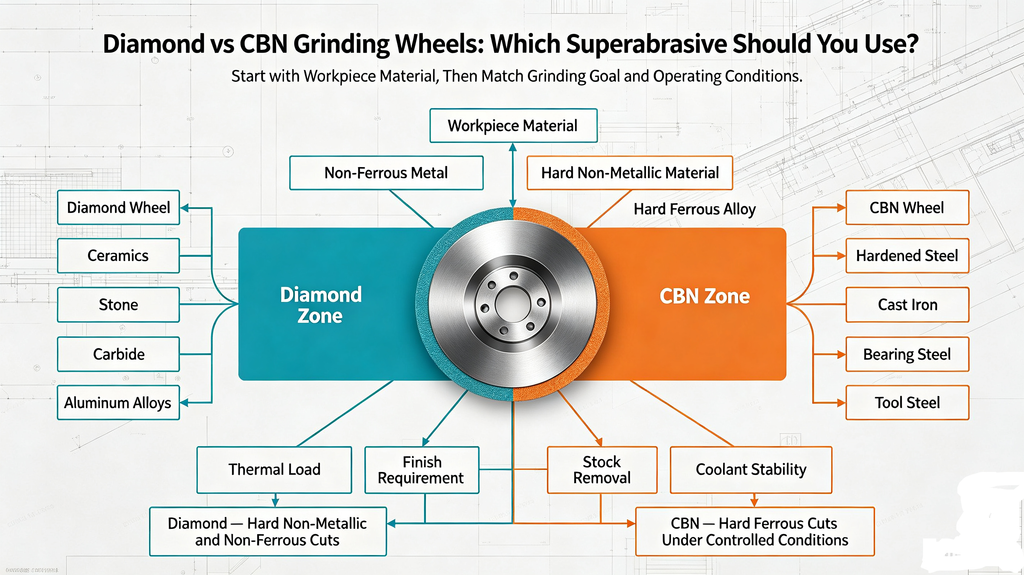
Diamond vs CBN grinding wheels: the core rule of chemistry
Diamond is the hardest material known, yet a diamond vs CBN grinding wheel choice cannot be made on hardness alone, because diamond fails badly on steel and other ferrous alloys. At grinding temperatures, carbon from the diamond diffuses into the iron, a process called graphitisation, and the grain wears away almost instantly. CBN (cubic boron nitride) is slightly less hard but is chemically stable against iron, which is why CBN — not diamond — is the correct choice for hardened steel. The same chemical logic drives the whole family of superabrasives, as described in Wikipedia’s overview of superabrasives.
When to use diamond grinding wheels
A diamond vs CBN grinding wheels decision starts with the workpiece, so check the material first.
- Non-ferrous metals: aluminium, copper, brass and PCD tooling.
- Ceramics, glass and stone: hard, brittle, non-metallic materials.
- Cemented carbide and cermets used in cutting tools.
- Composites and plastics, where a sharp free cut is needed.
Our diamond grinding tools range covers resin, metal, vitrified and electroplated bonds for exactly these materials.
When to use CBN grinding wheels
- Hardened tool and die steel above roughly 45 HRC.
- High-speed steel drills, taps and reamers.
- Cast iron and some superalloys (nickel and cobalt based).
- Camshafts, crankshafts and bearings in automotive production.
Because CBN tolerates heat far better, it also handles higher-speed, higher-pressure grinding than diamond on ferrous work. For a deeper look at the wider family of grinding wheels, see Wikipedia’s article on grinding wheels.
Quick comparison: diamond or CBN?
- Workpiece: diamond → non-ferrous / non-metallic; CBN → ferrous / high-temperature alloys.
- Hardness: diamond harder; CBN more heat-stable on steel.
- Cost: CBN usually costs more per wheel but lasts far longer on steel.
- Bond options: both available in resin, metal, vitrified and electroplated bonds.
If you are still weighing the abrasive, our guide to electroplated diamond tools explains how a single-layer tool differs from a bonded one.
Does bond choice matter more than abrasive?
Often, yes. A resin bond is soft and free-cutting; a metal bond holds form and lasts; a vitrified bond is porous and cool-cutting. Whichever abrasive you choose, the bond must match the machine, the coolant and the finish spec. Our grinding wheel selection guide walks through bond, grit and concentration in detail, and our resin vs metal bond comparison covers the most common bond question directly.
Common mistakes with diamond vs CBN grinding wheels
Most diamond vs CBN grinding wheels failures come down to picking the abrasive by hardness alone.
- Using a diamond wheel on steel — fast wear and glazing.
- Using CBN at too low a speed, where it cannot cut freely.
- Ignoring coolant on high-contact-area grinding.
- Judging a wheel only on price per unit instead of cost per part.
Heat is the usual culprit behind all four; our guide to reducing grinding heat covers the fixes in detail.
FAQ
Can diamond grind hardened steel?
Not practically. Carbon diffusion into the steel destroys the diamond grain. Use CBN — this is the single most important rule in the diamond vs CBN grinding wheels decision.
Is CBN always better on cast iron?
CBN is the standard choice, though some grey cast irons can be ground with diamond when no iron-oxide interaction is expected. Test on the actual material before committing to a large order.
Which is cheaper in the long run?
Cost per part, not price per wheel, decides. On long ferrous runs CBN usually wins by a wide margin.
Need help choosing between diamond and CBN?
Tell us your workpiece material, hardness, machine and finish target and our engineers will recommend the right abrasive and bond. Browse our catalogue or contact us for a quote.