

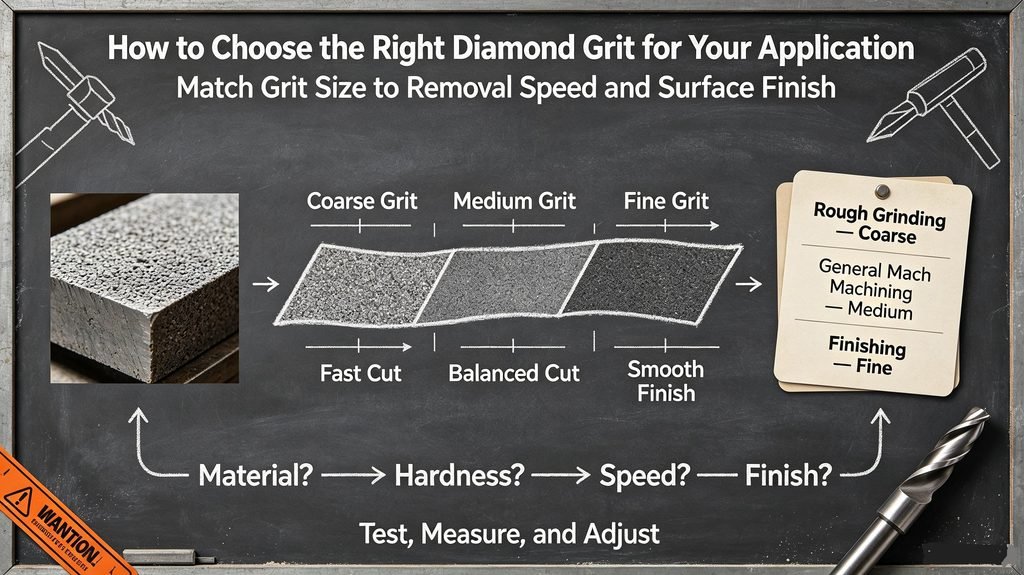
Choosing the right diamond grit is the single biggest lever on both stock removal and surface finish. Pick too coarse and you spend the rest of the job removing scratches; pick too fine and the tool glazes and stops cutting. This guide explains how diamond grit is measured, how to step through a grit sequence, and how to choose diamond grit for the most common materials.
What this grit actually means
Diamond abrasive is graded by grain size, following the same principles as abrasive grading, and there are two scales you will meet in practice:
- Mesh / PPI (roughly 30#–400#): coarser bonded products such as wheels, belts and stones, where grain is classified by sieve size. A higher number means a finer grain.
- Micron (roughly 400# upward, e.g. 3,000#–50,000#): fine and superfine finishing products, measured in microns. Here the number is the average particle size, so a 3 µm product is far finer than a 30 µm one.
The practical rule is simple: a finer grit size gives a better finish but removes less material, runs hotter and costs more; a coarser the grit cuts faster and cooler but leaves a rougher surface. Every grit decision is a trade between those two ends.
How to build a your grit sequence
Never try to jump straight to a mirror finish. Work in steps and let each step remove the scratches of the previous one. A reliable pattern is to roughly double the fineness at each step — for example 120# → 240# → 400# → 800# → 1,500# → 3,000#. Skipping a step is the most common cause of visible scratch marks and wasted polishing time, because the finer the diamond abrasive cannot remove the deeper scratch pattern left behind.
Matching grit selection to material
Glass and ceramics
Start coarse for shaping and step down. Typical shaping runs 80#–120#, smoothing 240#–400#, and fine finishing 800#–1,500#. For edge work on glass, an electroplated core drill followed by progressively finer grit choice gives a chip-free edge.
Carbide, PCD and hardened steel
Use resin or metal bonded wheels in the grade matched to the required edge quality. Coarser grits (100#–180#) suit rough profiling; finer grits (400#–1,500#) are used for edge preparation before polishing. See our electroplated diamond grinding wheels and flexible resin diamond grinding wheels for typical ranges.
Stone, marble and quartz
Progressive polishing from 50# up to 3,000# produces a mirror finish. Flexible resin belts and discs are the workhorse here because they follow contours without gouging — take a look at our flexible resin diamond abrasive belt and diamond coated stainless steel abrasive discs.
Superhard cutting tools (PCD / PCBN)
Diamond grit choice controls edge quality directly. Coarse grits are used for rough profiling of the tool body, while fine grits prepare the cutting edge for a long, consistent life. Our guide on PCD vs PCBN explains how the right grit fits into the wider tooling decision.
Diamond grit vs concentration: don’t confuse them
Diamond grit is the size of the grain. Concentration is how much diamond is packed into the bond. Two wheels can share the same this grit but behave very differently at different concentrations. Higher concentration gives more cutting points, a longer life and better form-holding but runs hotter and costs more; lower concentration runs cooler and is often better for large contact areas. Read more in our diamond grinding wheel selection guide.
Common grit size mistakes
- Starting too fine. It feels gentler, but it glazes quickly and removes material far too slowly.
- Skipping steps. The classic cause of scratches that appear during polishing.
- Using one the grit for the whole job. Rough and finish really do need different grits.
- Ignoring coolant. Fine grits generate heat fast; run them wet wherever possible.
Quick your grit reference
- Shaping / heavy removal: 30#–120#
- General grinding: 120#–400#
- Fine finishing: 400#–1,500#
- Polishing / mirror: 1,500#–50,000# (or 15 µm down to 1 µm)
Need help specifying the diamond abrasive?
Tell our engineers the material, the finish you need and the machine you are running, and we will recommend a grit selection sequence and the right tool for each step. Browse the full range in our product catalogue or contact us with your application.