

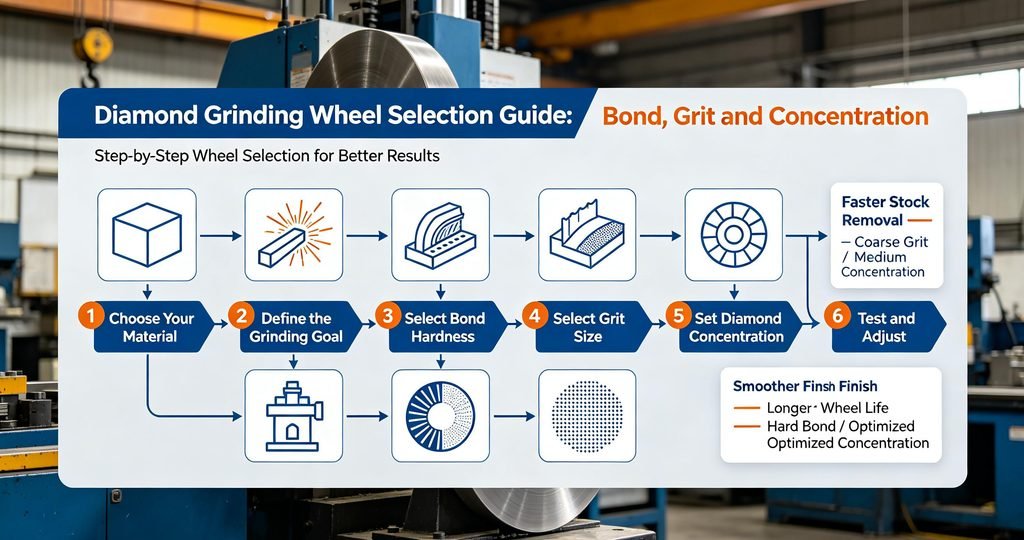
A diamond grinding wheel is not a single product; it is a combination of four variables working together. Understanding them lets you specify a diamond grinding wheel that cuts efficiently and lasts, instead of guessing at whatever is on the shelf. This guide walks through bond, grit, concentration and bond hardness in the order that matters
1. Diamond grinding wheel bond type
The bond holds the diamond grain and controls how the wheel releases worn grit. It is the first thing to choose for any diamond grinding wheel.
- Resin bond: sharp, cool cutting with a good finish. The first choice for carbide, PCD and precision finishing. See our resin bond diamond grinding disc.
- Metal bond: strong and long-lasting, preferred for glass, ceramics, stone and heavy stock removal. See our metal bonded diamond dressing wheels.
- Vitrified bond: free-cutting, heat-resistant and dressable, ideal for precision and creep-feed grinding. Our vitrified bond diamond cup grinding wheel is a typical example.
- Electroplated: a single layer of diamond on a machined steel form, ideal for complex profiles and one-off shapes. See the electroplated tools guide.
- Ceramic / hybrid: combines free cutting with high durability for demanding production jobs, such as our ceramic bonded diamond CBN grinding disc.
2. Grit size
Coarse grits remove material quickly with a rougher finish; fine grits deliver a better finish with far less removal. For a two-stage process, rough at 100#–180# and finish at 400#–1,500#. Grit selection is covered in full in our diamond grit guide.
3. Concentration
Concentration is the amount of diamond packed into the bond of a diamond grinding wheel, and it is often confused with grit. Higher concentration means more cutting points, a longer life and better form-holding, but it costs more and generates more heat. Lower concentration runs cooler and is often better for wide contact areas or where coolant is limited. For most production grinding, a mid-range concentration gives the best balance of life and cost.
4. Bond hardness (grade)
Bond hardness is about self-sharpening, and it follows the same logic as hardness in abrasive tooling. A softer bond releases worn grain sooner, which keeps the wheel sharp — good for hard, dense workpieces and for machines that cannot push hard. A harder bond holds the grain longer, giving better form retention and life on soft, abrasive materials, but it can glaze if the wheel is not dressed regularly.
Matching a diamond grinding wheel to the job
- Carbide tool grinding: resin bond, fine grit, medium concentration, medium-hard bond.
- Glass and ceramic: metal bond, coarse-to-medium grit, higher concentration.
- Precision and creep-feed: vitrified bond, fine grit, medium concentration, dressable.
- Complex one-off profiles: electroplated, grit matched to the finish required.
- Stone and quartz: metal or flexible resin, progressive grits, moderate concentration.
Machine and coolant matter too
The best diamond grinding wheel still underperforms on a machine that is not rigid or not supplied with adequate coolant. Rigidity controls whether a fine edge survives; coolant controls heat at the contact zone, which is what destroys resin bonds and fine grits first. Before blaming the wheel, check spindle runout, wheel balance, coolant flow and concentration.
Need help specifying a diamond grinding wheel?
Send us the material, the machine, the finish you need and the production volume, and our engineers will recommend a bond, grit and concentration combination. Browse our diamond grinding wheel range or contact us with your application.