

The bond of a diamond wheel controls how the grain is held, how freely it cuts and how long it lasts. Resin vs metal bond is the most common comparison in superabrasive grinding, and the choice shapes the finish, the form retention and the cost per part far more than most buyers expect.
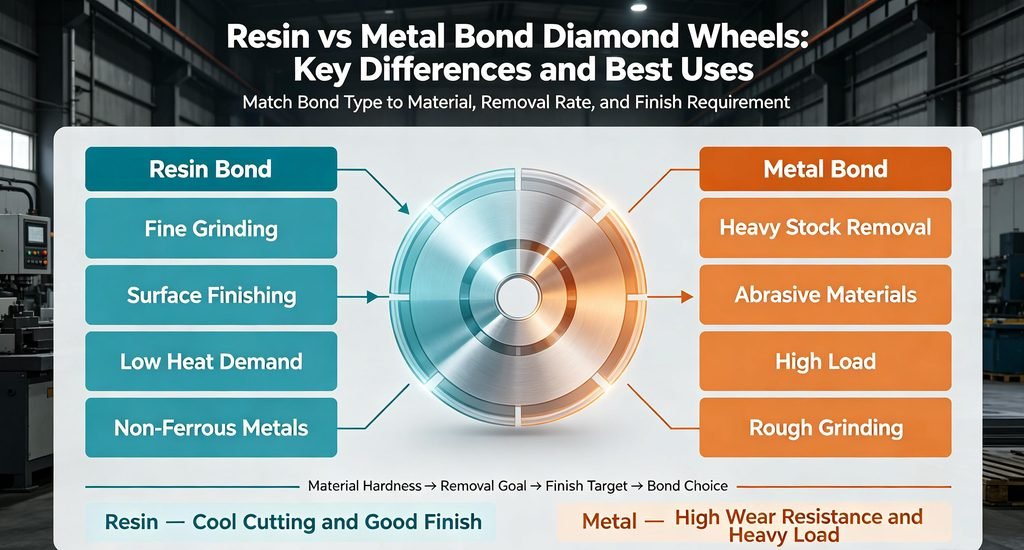
Resin vs metal bond: how a resin bond works
Thermoset resin holds the diamond grain in a tough, slightly elastic matrix. Because resin wears relatively quickly, new grain is exposed continuously, which keeps the wheel sharp and free-cutting. That self-sharpening behaviour suits fine finishing, low-to-medium pressure and heat-sensitive parts. Resin bonds dominate in polishing and finishing and in dry or light-coolant operations.
How a metal bond works
A metal bond (often bronze-based, sometimes sintered) grips the grain far more rigidly. It wears slowly, so the wheel holds its form and delivers an excellent cost per part on high-volume work. The trade-off is that a metal bond can glaze if it is not dressed or if the machine cannot supply enough power. Metal bonds are the workhorse for precision grinding of glass, ceramics and carbide.
Resin vs metal bond: direct comparison
The table below summarises the resin vs metal bond trade-offs at a glance.
- Cutting feel: resin free-cutting and cool; metal rigid and form-holding.
- Finish: resin typically finer; metal can achieve very precise forms.
- Wear: resin wears faster but self-sharpens; metal wears slowly but can glaze.
- Heat: resin prefers light cuts; metal tolerates heavier pressure.
- Cost per part: resin lower for finishing; metal lower for high-volume forming.
- Dressing: resin rarely needs heavy dressing; metal needs scheduled dressing.
The underlying physics is the same as general abrasives, outlined in Wikipedia’s article on grinding wheels.
Which bond should you pick?
- Choose resin for fine finishes, heat-sensitive materials, low pressure and mixed low-volume jobs.
- Choose metal for high-volume production, tight dimensional tolerance and long wheel life.
- Consider vitrified when you want a porous, cool cut with good form retention.
- Consider electroplated for complex profiles and thin coatings where the form is the hard part.
The same decision appears one level up when you compare diamond vs CBN grinding wheels, and again at the tool level in our electroplated vs bonded diamond tools guide.
Bond, grit and concentration together
Whichever resin vs metal bond you choose, the grit and concentration must suit the job.
Bond choice cannot be made in isolation. A hard bond with a coarse grit behaves very differently from a hard bond with a fine grit, and concentration changes both life and finish. Our selection guide explains how the three interact, and our grit guide covers grain choice separately.
How to dress a resin vs metal bond wheel
Dressing is where the resin vs metal bond difference shows up again. A resin bond is usually dressed lightly to open the face and restore the cut.
Over-dressing a resin wheel wastes its short life, so keep passes minimal.
A metal bond is different. It often needs a harder, scheduled dressing operation to break glaze and re-expose grain, because it will not self-sharpen quickly on its own.
On a metal bond, track dressing by spindle load or spark-out time rather than by eye.
Getting this right is the difference between a wheel that pays for itself and one blamed for poor finish. For the wider picture, see our diamond grinding wheel selection guide.
FAQ
Which bond gives the better finish?
Usually resin, because it stays slightly elastic and self-sharpens, resisting glazing at fine grits.
Can a metal bond be used for polishing?
It can, but for high-gloss polishing a resin or flexible bond is usually faster and cooler.
Why does my metal-bond wheel glaze?
Often too little power, too fine a grit, or insufficient dressing. Check all three before changing the wheel.
Get the right bond for your process
Share your material, machine and finish spec and we will match the resin vs metal bond choice, grit and concentration to your job. Browse the catalogue or request a quote.