

Most diamond grinding wheel problems look different but come from the same few causes: the bond is wrong for the material, the wheel is not being dressed, or the machine is pushing the wheel harder than the diamond can cut. A systematic diamond grinding wheel troubleshooting routine saves hours of guesswork, and this guide walks through the six faults operators see most often, what causes each one, and how to fix it without replacing the wheel.
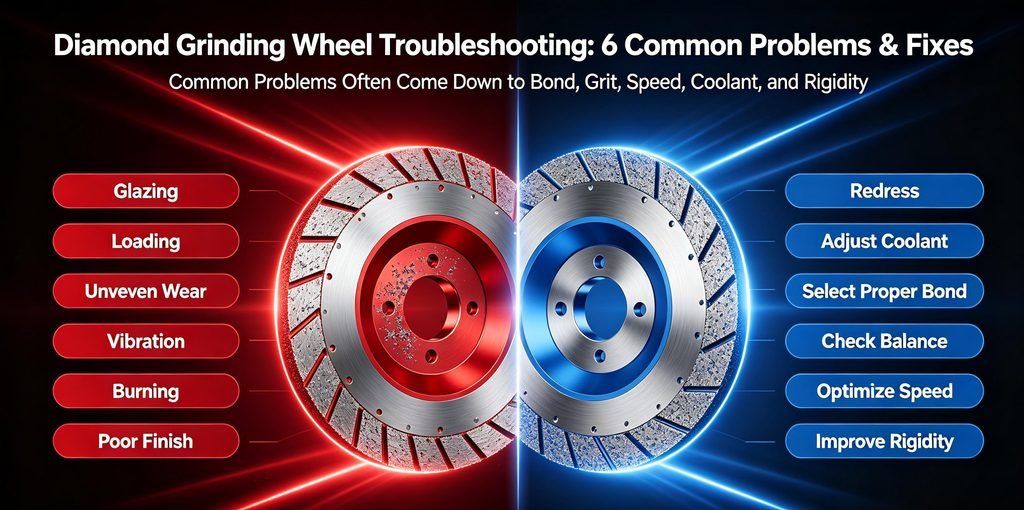
If you are new to superabrasive wheels, pair this diamond grinding wheel troubleshooting guide with our diamond grinding wheel dressing steps and our bond and grit selection guide.
1. Loading: the wheel face is packed with swarf
Symptom: the wheel looks shiny and full, cut rate drops, and the workpiece gets hot even though the wheel is not glazed.
Cause: chips of the workpiece are welding into the pores between the diamond grains. Soft, gummy materials (aluminium, stainless, some plastics) load far more easily than hard, brittle ones. A bond that is too hard for the material also stops the grains from releasing, so the loaded layer never clears.
Fix: dress the wheel to open the pores, reduce the depth of cut, and increase coolant flow so chips are flushed away. For soft materials, switch to a coarser grit and a softer, more open bond. A vitrified bond cup wheel with good porosity resists loading better than a dense resin wheel on gummy stock – a common finding in diamond grinding wheel troubleshooting.
2. Glazing: the wheel is polished smooth and rubs instead of cutting
Symptom: spark flow nearly stops, the wheel face is bright and glassy, and the workpiece burns.
Cause: heat and friction have flattened the exposed diamond, so the wheel skates across the surface. Too fine a grit, a bond that is too hard, too high a wheel speed, or a feed that is too light (which lets the wheel rub rather than bite) all cause glazing.
Fix: dress the wheel to expose fresh grain, then reduce wheel speed and increase feed so each grain takes a real chip. If glazing returns quickly, move to a softer bond or a coarser grit. Our guide to reducing grinding heat and burn covers the parameters in detail.
3. Burning and heat damage on the workpiece
Symptom: blue or brown scorch marks, a heat-affected layer, or micro-cracks in the workpiece.
Cause: burning is usually a downstream effect of loading or glazing – a dull wheel rubs, friction climbs, and heat pours into the part. Low coolant pressure, a wheel that is too hard, or an excessive depth of cut make it worse.
Fix: restore the wheel face by dressing, then rebalance the parameters: lower wheel speed, higher table feed, correct depth of cut per pass, and flood coolant aimed directly at the contact zone. The machining research community consistently finds that coolants and wheel speed dominate surface integrity on hardened steels. On heat-sensitive steels, a CBN wheel runs cooler than diamond because it conducts heat away from the cut, which solves this diamond grinding wheel troubleshooting case at the source.
4. Chatter and vibration
Symptom: a rippled finish, a rhythmic whine, or visible marks spaced evenly across the work.
Cause: chatter comes from an unbalanced wheel, a wheel that has lost its form, a loose mount, or a worn spindle. Pushing a glazed wheel can also excite vibration because the wheel is bouncing rather than cutting.
Fix: true and balance the wheel, check the flange and spindle for runout, and confirm the wheel is seated flat. Re-dress to restore concentricity, then resume with a lighter first pass. A metal bonded dressing wheel is the fastest way to true a badly out-of-form wheel.
5. Loss of form and profile
Symptom: corners round off, the profile drifts, and finished parts fall out of tolerance.
Cause: the wheel edge wears unevenly, often because the same zone does most of the cutting, or because the bond is too soft for an abrasive workpiece. Plunge grinding a sharp corner loads one spot and wears it fast.
Fix: dress the form back with a CNC dressing tool, then spread the wear by using more of the wheel width or by staggering the passes. For profiling jobs, choose a harder bond or a coarser grit that holds its edge longer.
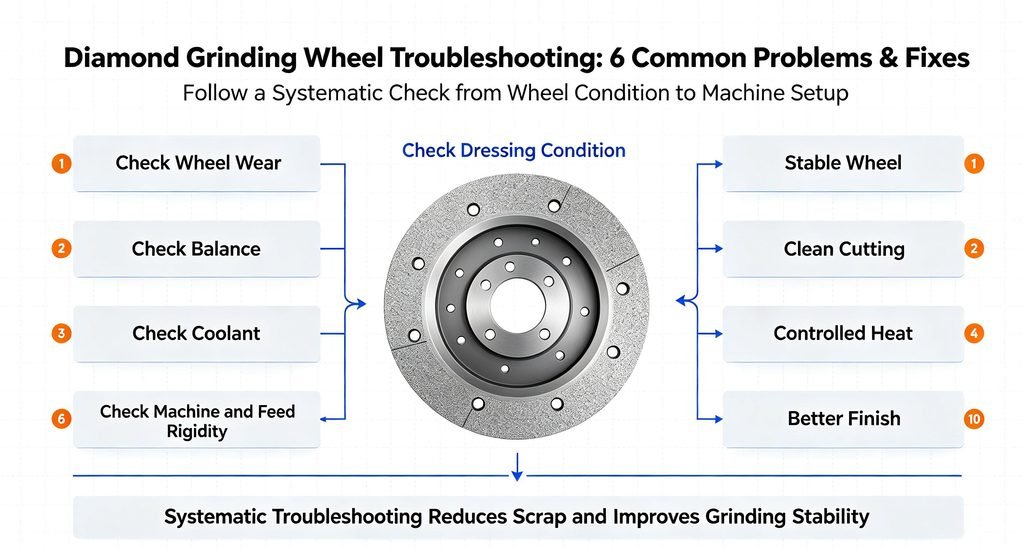
6. Poor surface finish
Symptom: a scratched, hazy or inconsistent finish even when the wheel is cutting freely.
Cause: finish problems trace back to grit size, wheel condition and spark-out. A loaded or glazed wheel drags and tears the surface; too coarse a grit leaves visible scratch marks; and skipping the spark-out pass leaves feed marks behind.
Fix: dress the wheel, finish with a finer grit for the last passes, and add a spark-out (a few seconds of dwell with no infeed) to let the wheel clean up. Keep coolant clean – recirculated swarf scratches the finish even with a perfect wheel. For a full parameter review, see the SME grinding resources on wheel selection and dressing.
Quick troubleshooting chart
- Loading – shiny, packed face – dress, softer/open bond, more coolant
- Glazing – glassy face, no sparks – dress, lower speed, higher feed
- Burning – scorch marks – fix loading/glazing, flood coolant, lower depth of cut
- Chatter – rippled finish – balance, true the wheel, check the mount
- Form loss – rounded corners – re-dress the profile, harder bond, spread wear
- Poor finish – scratches – finer grit, spark-out pass, clean coolant
Match the wheel to the job before you troubleshoot
Half of all diamond grinding wheel troubleshooting ends with the same answer: the wheel was never matched to the material. Hard, dense workpieces want a soft bond and a finer grit so the wheel keeps exposing fresh diamond. Soft, abrasive workpieces want a hard bond and a coarser grit so the wheel resists wear. When you are unsure, our diamond vs CBN grinding wheel comparison explains which superabrasive suits which steel.
Frequently asked questions
Why is my diamond grinding wheel not cutting?
Almost always because it is glazed: the diamond has flattened and the wheel rubs instead of cutting. Dress the wheel to expose fresh grain, then lower the wheel speed and increase the feed.
How often should I dress a diamond grinding wheel?
Dress on a fixed cycle based on parts or minutes, and immediately whenever you see burning, rising load or a shiny, loaded face. Regular light dressing is far better than letting the wheel glaze and dress it back hard.
Can a glazed diamond wheel be restored?
Yes. Glazing is a surface condition, not permanent damage. Dressing removes the dull layer and exposes the diamonds underneath, which is why dressing is the first step in almost every fix here.
Should I use diamond or CBN for hardened steel?
For hardened steel and most ferrous work, CBN is the better choice because it resists chemical wear and runs cooler. Diamond suits carbides, ceramics, glass, stone and other non-ferrous or abrasive materials.
Still fighting a wheel that will not behave? Tell CDFIT your material, machine and finish target and we will recommend the right bond, grit and dressing tool for the job.