

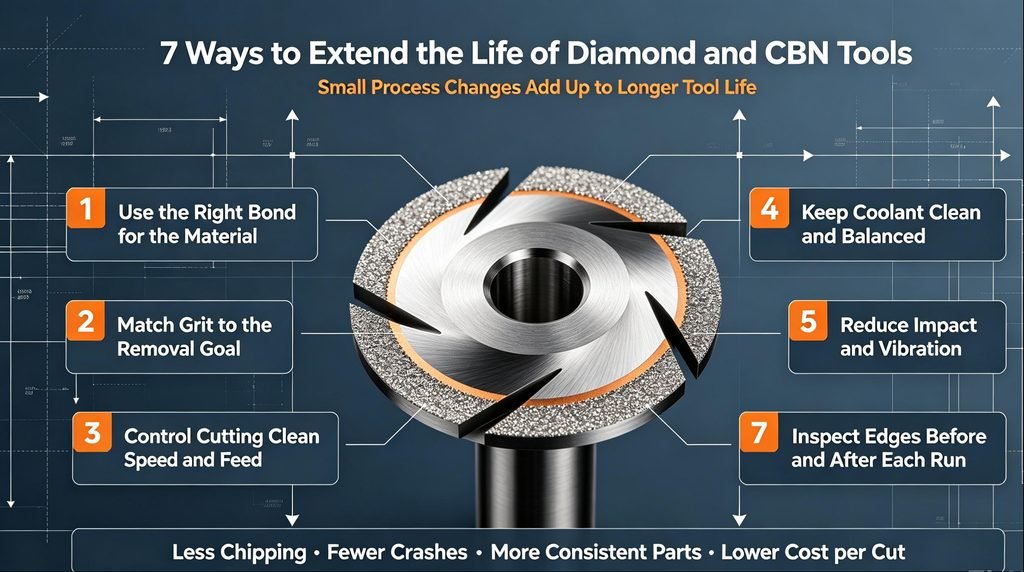
Diamond and CBN tools are an investment, and the way you run and maintain them often matters more than the tool itself. These seven habits reliably extend the life of diamond and CBN tools — and the savings show up on every part you produce afterwards.
1. Use the right speed and feed
Running diamond and CBN tools too fast glazes the bond and burns the workpiece. Running them too slow reduces efficiency and can load the tool with swarf. Start from the supplier’s recommended range and adjust for the material; if the finish degrades and the tool feels slick, you are almost certainly running too fast. Speed and feed are the first variables to check before blaming the tool.
2. Use coolant correctly
Water or the recommended coolant carries away heat — the number one enemy of resin bonds and fine grits in diamond and CBN tools. Direct the flow at the contact zone, not at the top of the wheel, and keep the concentration and cleanliness of the coolant within spec. Dirty coolant recirculates abrasive fines that accelerate wear and shorten tool life.
3. Never skip grit steps
Jumping grades overloads the tool and produces scratches that cost more time to remove than the skipped step would have taken. Work through a proper sequence, roughly doubling fineness at each step; our diamond grit guide covers the details. Consistent stepping is the single easiest habit to adopt.
4. Dress and true bonded diamond and CBN tools
A glazed or out-of-round wheel cuts poorly and wears unevenly. Regular dressing restores the sharp grain and the wheel’s form. Electroplated tools cannot be dressed — when they wear out they are replaced — so treat them gently and let the abrasive do the work. Dressing on a fixed schedule beats dressing only when the finish has already gone bad.
5. Match bond hardness to the job
A bond that is too hard for a soft, abrasive material glazes; too soft for hard work wears away before the grain is spent. If you find yourself dressing constantly or burning parts, the bond — not the operator — is probably wrong. Our selection guide explains the trade-offs in detail.
6. Handle and store correctly
Protect the edges of diamond and CBN tools in their cases, keep abrasives dry and clean, and never stack heavy items on belts or discs. Chipped edges from careless storage cause the same failure as a bad cut, at zero production value. A simple rack and a labelled case prevent most avoidable damage.
7. Record what wears and why
A simple tool log — tool, material, parameters, parts produced, reason for replacement — tells you when a change of grit, bond or parameter will pay off. Most life improvements come from noticing a pattern, not from buying a new tool. Following the same logic as {{grinding}}, consistency beats one-off tweaks, as in grinding.
When to replace diamond and CBN tools
Replace when the tool glazes even after dressing, when the finish degrades despite correct parameters, or when dimensions drift outside tolerance. Pushing a worn tool usually costs more in scrap and rework than the tool costs to replace. For dressing tools specifically, see our diamond dressing tools for CNC lathes, and for grinding wheels start from our resin bond diamond grinding disc.
Extend life consistently, not occasionally
None of these seven habits is dramatic on its own, but together they compound. Shops that standardise speed, coolant and dressing practice typically see tool life rise by a third or more, with a matching drop in scrap and rework. The point is not to rescue a dying tool — it is to stop wasting good ones.
Need advice on diamond and CBN tools?
Our engineers can review your process and recommend the tool and parameters that maximise life for your specific application. Browse our catalogue, or get in touch and describe what you are running.