

Buyers often ask whether to use electroplated vs bonded diamond tools, expecting a simple “which lasts longer” answer. The honest answer is that they are built for different jobs, and the right choice depends on the form, the volume and the pressure of the work.
Electroplated vs bonded diamond tools: how they are built
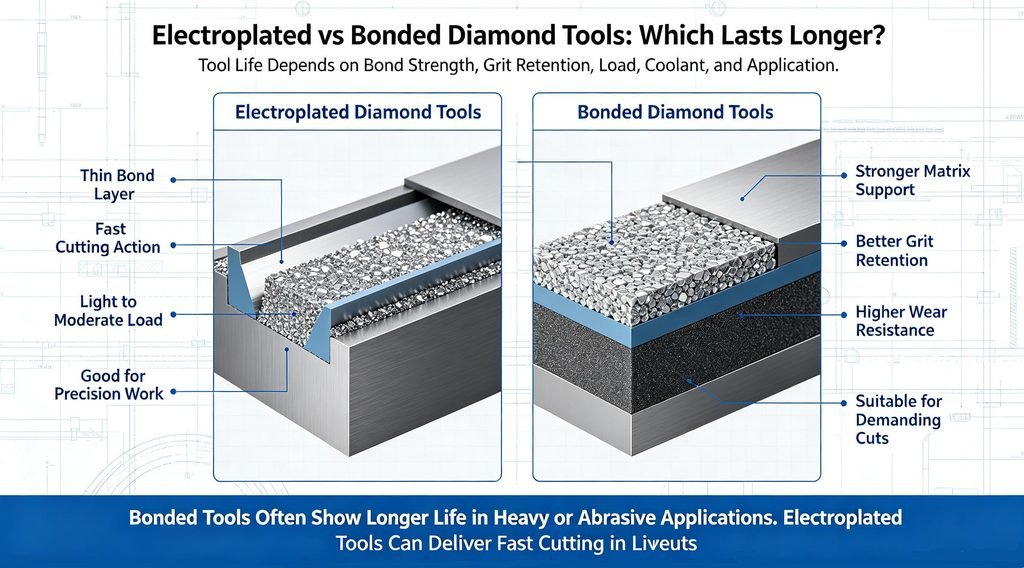
An electroplated diamond tool has a single layer of diamond held in a nickel matrix on a machined steel body. A bonded tool mixes diamond grain throughout a resin, metal, vitrified or ceramic bond, so fresh grain is exposed as the tool wears. That structural difference explains every behavioural difference that follows.
How each tool behaves
The practical differences between electroplated vs bonded diamond tools come from that construction.
- Electroplated: razor-sharp when new, very free-cutting, thin layer, replaced rather than dressed, lowest tooling cost for complex forms.
- Bonded: sharpens itself as it wears, holds form for a long time, can be dressed, best cost per part under sustained load.
Which lasts longer?
On pure life, most buyers find the electroplated vs bonded diamond tools answer favours the bonded tool under sustained load.
On pure life, the electroplated vs bonded diamond tools answer favours the bonded tool under load.
Under heavy, sustained, small-contact-area grinding, a bonded tool almost always outlasts an electroplated one, simply because it has far more diamond in reserve. But “lasts longer” is the wrong question on complex profiles or thin coatings, where a bonded tool cannot be made economically at all. There, the only practical choice is electroplated.
Decision guide
- Choose electroplated for complex or thin forms, low volume, one-off jobs, fast turnaround and sharp cutting on glass, ceramics and composites.
- Choose bonded for high-volume production, tight tolerance, long tool life and dressing.
- Use both in the same shop: electroplated for profiling and odd jobs, bonded for the production line.
The same trade-off is visible in coated abrasives generally, described in Wikipedia’s article on abrasives.
Related choices in superabrasives
Electroplated vs bonded diamond tools is one of several choices in the superabrasive family.
The electroplated vs bonded diamond tools question sits alongside other common decisions. If you are choosing the abrasive itself, see our diamond vs CBN grinding wheels guide; for bonded wheels specifically, our resin vs metal bond comparison is the place to start.
Getting the most from each type
For electroplated tools, control the first pass, use coolant, and replace as soon as the edge stops cutting. For bonded tools, dress on schedule and match the bond to the material. More maintenance habits are covered in our tool life guide, and grit choice in our diamond grit guide.
Electroplated vs bonded diamond tools: cost per part in practice
The sticker price favours electroplated tools almost every time. A single-layer plated tool on a machined body is cheap to make and cheap to replace.
But sticker price is not the number that matters on a production line. What matters is cost per part, which folds in tool life, downtime to change the tool, and scrap from a dull edge.
Run the numbers over a full batch. An electroplated tool that lasts two hours but costs a tenth as much can beat a bonded tool on short runs, and lose badly on long ones.
For one-off profiling and awkward forms, there is often no bonded option at all, so electroplated wins by default. For anything running day after day in the same material, bonded tools usually win on cost per part.
The same cost-per-part logic applies across the whole superabrasive range, from grinding wheels to saw blades. If you want help running the numbers for your own job, our engineers will model it with you.
FAQ
Can electroplated tools be re-plated?
Some suppliers can strip and re-plate a body, but the cost usually favours a new tool. Ask before assuming.
Why do my electroplated tools wear so fast?
Usually rubbing instead of cutting, no coolant, or the wrong grit for the stock being removed.
Are bonded tools always more expensive?
Per unit yes, per part often no. Calculate cost per part over a full production run.
Let us match the tool to your job
Send us your drawing, material and volume and our engineers will recommend electroplated vs bonded. Browse the catalogue or request a quote.